David Goldklang, designer
Objects, modeled in code
Parametric models written in Python, rendered for review, then printed in multiple colors on a Bambu printer.


Chess box
A chess set that is its own box
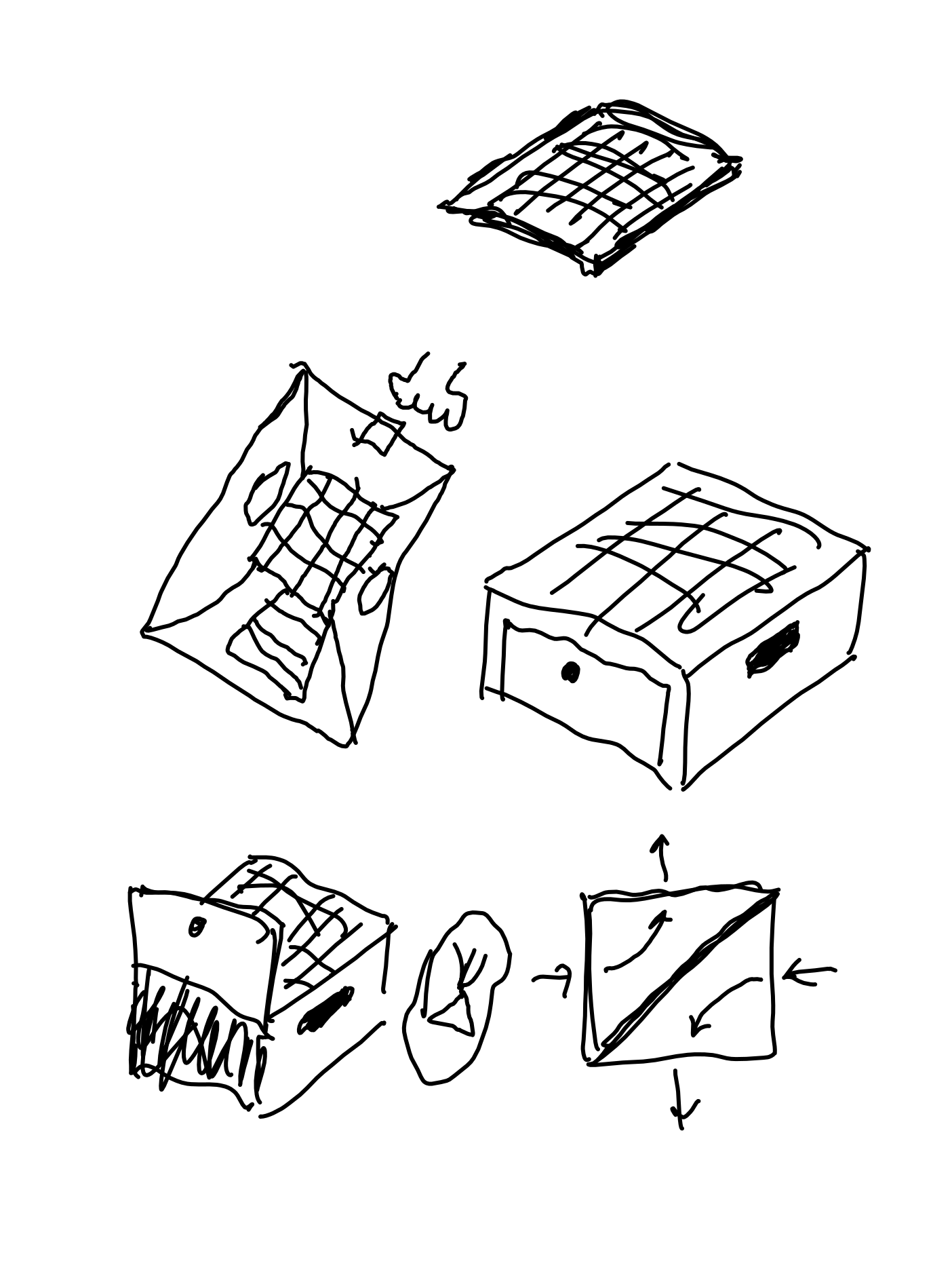
Each player has a sliding tambour door, a curtain of slats on a printed hinge, that runs round a corner and tucks away inside. Captured pieces drop into that player’s chamber through a hole in the side, and magnets under every square snap the pieces to center.
- Modeled
- In Python (manifold3d), not drawn in CAD
- Printed
- Bambu Lab X2D, four colors with the AMS
01From a sketch
It started on a tablet
A sketch on a reMarkable tablet: a chessboard on top and storage for the set below, with a front that slides away like a garage door.
02The doors
A roll-up front for each player
- Tambour doorsSlats on a printed hinge film run in grooves round a corner and slide inside the box.
- Captured piecesEach player's captures drop through a hole in the side into their own chamber.
- Magnets64 under the squares and 32 in the pieces: everything stays put when the box moves.
- Swappable topsThe board is a separate faceplate, so the box can take other games; a backgammon top is in progress.
03Printed
The real set
- 0
- mm square, about 86 mm tall
- 0
- colors: black, candy red silk, jade white, and TPU feet
- 0
- magnets in the box, faceplate and pieces
- 0
- hours of printing, all parts together
Pieces: BenXC’s “Chess Set Pieces Figures” from MakerWorld, scaled down with magnet pockets added. The box, doors and board are my own design.
OtterSpace
Tags that bring lost things home
Zipper pulls for kids’ backpacks and jackets that tie into OtterSpace, my school app. The otter is on the front; on the back, a QR code opens that item’s lost-and-found page.
- Modeled
- A Python generator: a code and a size in, a model out
- Printed
- Two colors in one print
01Design
A QR code that never wears off
- InlaidThe QR code is printed in a second color, inlaid into the face, so it can't rub off.
- As big as it can beA short domain plus a 4-character code fits the smallest QR format (21 by 21), so each square is as large as the tag allows.
- CheckedThe generator checks that every code scans before it outputs a model; the printed 1" and 7/8" tags scan on an iPhone.
- Tap tooA hair tie loops round a post inside the tag, and an NFC chip can be sealed in so a phone tap works as well.
Water lamps
Planters that glow from below
Planters for my water-grown plants that sit on a small LED puck light, so the light comes up through the water and the thin printed walls. Both start from other designers’ models; my changes are what make them work as water lamps.
- Modified
- In Python (trimesh, manifold3d), with collision checks
- Printed
- Bambu Lab X2D: PLA shell, clear PETG liner
01Zigzag lamp
A clear liner holds the water
- Watertight linerA separate clear PETG liner holds about 400 ml, so the textured shell never has to be waterproof. The second version fixed a slight weep at the base.
- Light from belowA pocket and cable notch for the puck underneath, and a light hole flared at 45° so it prints without supports.
- Two colorsA black base band under the white textured body, and a heavy black lid with a hole for the plant.
02Parts
Shell, liner, lid and puck
Shell remixed from a two-color zigzag vase on MakerWorld.
03Zigzag planters
The same texture, small
A two-color zigzag vase from MakerWorld, scaled down, with my own drip tray.
04Glow planter
Refit to the light I had
The original was made for a different lamp kit. I refit it to my puck light by widening the cable channel, merged its 61 overlapping shells into one clean solid, and thinned the walls in white PLA so it glows.
Remixed from “Hydroponic / planter / lamp” by Peter Hall on MakerWorld.